
Enterprise AI Is No Longer Optional
Yet Most Organizations Are Failing
A growing body of research shows that 95% of enterprise AI initiatives fail to deliver meaningful return. Not because the technology doesn’t work. Because organizations are solving the wrong problem.
The Trillion-Dollar Misdiagnosis
There is broad consensus – among economists, industry researchers, and the C-suite – that enterprise AI represents the most consequential capability shift since electrification, and possibly the most important technological development of all time.Organizations understand the stakes. They are spending accordingly. Collectively, hundreds of billions of dollars are already flowing into enterprise AI, and those investments are accelerating.And yet…
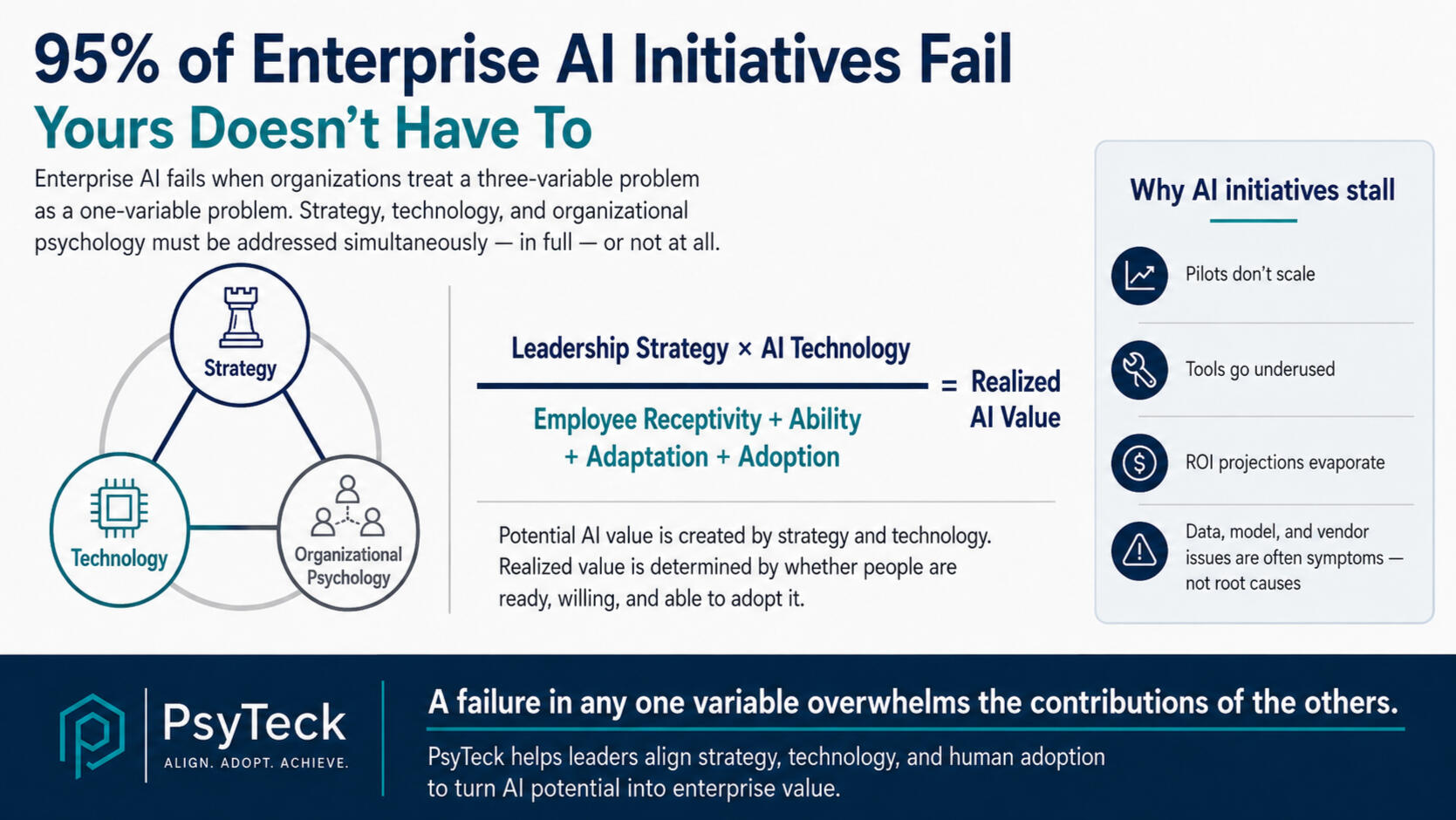
The pattern is remarkably consistent. Platforms are licensed. Chief AI Officers are appointed. Centers of Excellence are launched. And then, in the vast majority of cases, nothing much changes. Tools sit underused. Pilots don’t scale. ROI projections quietly evaporate.When organizations conduct the post-mortem, they land on familiar explanations: The data wasn’t ready, the model underperformed, the vendor overpromised.These are real problems. But they are symptoms, not causes.Enterprise AI implementation is a three-variable equation. Strategy and Technology are two of those variables – critical and non-negotiable.But without the third – genuine workforce receptivity, capability development, and sustained behavioral adoption – the other two produce nothing but expense. Millions of dollars and thousands of hours go precisely nowhere.

The Problem With Specialists
Most organizations treat AI implementation as a complicated problem – one with many moving parts, but ultimately solvable by dividing the work among the right experts.➤ Strategy consultants design roadmaps without adequate technology insights.➤ Technology advisors select tools without adequate behavioral context.➤ Change managers build workforce programs around strategies that the technologists have already devised.
The result is three parallel streams of competent work that never constitute a coherent whole.But AI implementation isn’t complicated. It’s complex.A complicated system – a jet engine, a tax return – can be decomposed into independent parts, each solved by a specialist, then reassembled. A complex system cannot.In a complex system, the parts interact. Strategy decisions reshape the technology landscape. Technology choices trigger psychological responses across the workforce. Workforce dynamics, in turn, redefine what any strategy can actually accomplish.Solving each dimension in isolation doesn’t just leave gaps between them – it generates new problems that none of the specialists were hired to see.PsyTeck was built around a different proposition: That strategy, Technology, and Organizational Psychology are not three separate dimensions of AI implementation. They are one system. They can only be managed effectively as one system.Our engagements address all three simultaneously – from initial conversation through sustained adoption.
Strategy
Objectives-first AI strategy, use-case prioritization, and governance architecture grounded in what you are actually trying to achieve.
Technology
Independent evaluation and selection of AI tools for strategic and organizational fit — not vendor prestige or technical novelty.
Psychology
Assessment and cultivation of the workforce conditions — receptivity, ability, adaptation, adoption — that determine whether strategy and technology produce results.
Ready to become one of the few?
Most organizations in your industry will make significant AI investments over the next three years. A small number will build a genuine, durable competitive advantage. The difference will not be the size of the budget. It will be whether someone held the strategy, the technology, and the human conditions for adoption simultaneously — and managed them as one system.
You Do Not Fail Because of the Technology
If your enterprise AI initiative has stalled, underperformed, or quietly dissolved, the explanation you were given is almost certainly incomplete. And if you haven’t failed yet, here’s why so many others have — and what can make your situation fundamentally different.Research consistently places the failure rate of enterprise AI initiatives at or around 95 percent. The conventional explanations — inadequate tooling, poor data quality, immature infrastructure — are real. But they are secondary. They describe what went wrong at the surface. They do not explain why it keeps happening.Almost every AI initiative that failed did so for the same underlying reason: The organization treated a three-variable problem as though it had only one.The technology almost always works.What doesn’t work is the organization it gets deployed into.
The technology almost always works.What doesn’t work is the organization the technology is deployed into.
The Three Variables



Every enterprise AI initiative — regardless of industry, scale, or ambition — is governed by the same equation. The numerator contains two variables, weighted equally: Strategy and Technology.
An AI strategy that is correct and clear but paired with the wrong tools produces beautifully reasoned failure.A state-of-the-art technology stack steered by an incoherent AI strategy produces expensive complexity that no one can govern.Neither variable compensates for weakness in the other.But even when both are done well, the outcome is determined by the denominator: The extent to which employees are genuinely receptive to AI, develop the specific capabilities to use it, adapt their workflows and behaviors around it, and ultimately adopt it into the fabric of their daily work.The denominator does not add to or subtract from the numerator. It divides it.A large denominator — accumulated workforce resistance, inability, and non-adoption — suppresses the value of even the strongest numerator toward zero.This is not a metaphor. It is how the math works.
Why Organizations Keep Getting It Wrong
They buy technology before they know what they need it to do. Most organizations begin their AI journey with tools, not objectives. A platform is licensed, a vendor is selected, a pilot is launched — and only then does anyone ask what business problem it was supposed to solve. The result is a growing portfolio of use cases connected by no governing logic. The pilots multiply. The coherence doesn’t.They select tools for the wrong reasons. Vendor prestige, competitive anxiety, and internal convenience are not strategic fit criteria. The best AI tool in the world, deployed in the wrong organizational context, is not a suboptimal solution. It is an obstacle.They systematically underinvest in two of the three variables. Most organizations allocate 80 to 90 percent of their AI budget to technology — licensing platforms, building infrastructure, deploying tools — while failing to develop a coherent AI strategy that connects those investments to actual business objectives, and investing only a residual fraction in workforce readiness. The result is a lopsided equation: an enormous technology spend that lacks strategic direction on one side and a prepared workforce on the other. Employee receptivity, capability, adaptation, and adoption are not a support function bolted on after the tools arrive. They are the denominator of the entire equation — and strategy is what ensures the numerator is worth dividing in the first place.They manage whatever they do invest in separately. Strategy, technology, and people are assigned to different specialists who optimize for their own domain without a shared model of how the variables interact. Strategy consultants design roadmaps without adequate technology constraints. Technology advisors select tools without adequate behavioral context. Change managers build workforce programs around strategies that the technologists have already devised. Three parallel streams of competent work — that never constitute a coherent whole.A failure in any one of these variables will overwhelm the contributions of the other two.There are no partial solutions.
A failure in any one of the three variables will overwhelm the contributions of the other two. There are no partial solutions.
The Opportunity
None of this is inevitable.Organizations that get all three variables right simultaneously — strategy grounded in actual objectives, technology selected for genuine fit, and a workforce that is truly prepared to adopt — do not merely improve their odds of AI success. They enter a different category of outcome. The AI advantage compounds. Every quarter in which it widens makes it harder for competitors to close.The window is not permanently open. In most industries, it is narrowing. The question is not whether AI will reshape your competitive landscape. It already is. The question is whether your organization will be among the few that built the capability to benefit from it — or among the many that funded the lesson.
Your Organization Already Holds Most of the Answers.
Our job is to help you find them — and then build on them.
Most consulting is extractive. The consultant arrives, collects information, retreats, and returns with conclusions. You are the subject of the analysis; the recipient of the pronouncement. We operate from a different premise entirely: that the most important insights about your organization’s AI opportunity do not live in pre-defined consulting frameworks. They live in your people — in what your teams already understand about your competitive position, your customers, your operational strengths, and where AI could genuinely change the game. Our role is to evoke that intelligence, organize it, and connect it to the strategic and technical knowledge we bring. The result is a direction that your organization doesn’t just understand — it owns.
01
We Take an Honest Account of Where You Stand
Most AI strategy engagements begin in one of two unproductive places. The first is a gap analysis — a systematic inventory of everything the organization lacks, which produces an accurate picture of the distance to travel and very little sense of how to get there. The second is a strengths inventory so relentlessly affirmative that it sidesteps the real obstacles and produces a strategy no one quite believes.
We do neither. We begin with a clear-eyed assessment of the full landscape: where your organization genuinely excels, where it struggles, and — critically — what each of those realities means for your AI opportunity.
Strengths are the obvious starting point. The processes that already run with unusual efficiency, the decisions your teams make with unusual accuracy, the customer relationships you manage better than anyone in your industry — these are the places where AI creates compounding leverage. Your competitors cannot easily replicate an AI-amplified strength they do not themselves possess.
Weaknesses are not simply constraints to be managed around. A persistent bottleneck that has resisted every previous fix because it required more consistency or speed than human teams could deliver may be precisely the kind of problem AI solves. In the right circumstances, AI can turn what you are not good at into something your competitors no longer hold over you.
Our first conversations are built around both. Where are you strongest, and how does AI compound that? Where have you been weakest, and is this a problem AI can convert? That picture defines the strategy. Not the other way around.
02
We Evoke, Rather Than Impose
External expertise has genuine value. We bring deep knowledge of the AI capability landscape, hard-won pattern recognition about what fails and why, and an analytical framework your team did not have before we arrived. We are not pretending to be neutral.
But expertise imposed on an organization that does not own it produces compliance, not commitment. Employees who have participated in discovering why AI matters — for their specific role, their specific challenges, the outcomes their organization actually cares about — become the driving force behind adoption rather than a source of resistance to it.
This is why our engagements are structured as genuine conversations, not briefings. We ask questions we do not already know the answers to. We bring our knowledge to bear on what you’ve shared, and together we arrive at a view that neither of us would have reached independently.
03
We Work Across All Three Dimensions — At Once
Whether you are setting out for the first time or accelerating an initiative already underway, the three-variable challenge is the same: strategy, technology, and organizational psychology are not sequential steps. They are simultaneous conditions. A strategic decision made without technology awareness produces a roadmap that cannot be executed. A technology selection made without behavioral context produces a tool that will not be adopted. A workforce readiness program built around a strategy the technologists have already revised is preparing people for a plan that no longer exists.
We hold all three in view throughout every engagement. The three variables interact continuously. Managing them separately — however expertly — is not the same as managing the system they constitute.
04
Our Objective Is Your Asymmetric Advantage
Adequate AI implementation is the floor, not the ceiling. Our goal is not to help you close the gap with your industry’s AI leaders. It is to help you become one — and then extend the distance.
The organizations that will define their industries over the next decade got three things right at the same time: a strategy grounded in their actual objectives, technology selected for fit rather than fashion, and a workforce genuinely prepared to use it. That convergence is rare. It happens when someone holds the whole system — and works with you to build it from your strengths outward.
We are not here to fix what’s broken.
We are here to help you build something your competitors cannot easily follow.
Advisory Services Across All Dimensions
Every engagement is grounded in the same conviction: strategy, technology, and human psychology must be addressed simultaneously, or not at all.
The following is an overview of PsyTeck’s advisory practice areas.
A complete services menu
— with full engagement descriptions, deliverables, and ideal-client profiles —
is available as a standalone document.



Strategy
An AI strategy that does not begin with organizational objectives is not a strategy — it is a procurement plan. PsyTeck’s strategy engagements establish the governing logic that makes every subsequent technology and implementation decision coherent, defensible, and measurable. Engagements range from comprehensive strategy development and governance architecture to targeted strategy audits and executive briefings.
Technology
The right technology is not the most powerful or the most widely adopted. It is the tool that most precisely fits the organization’s strategic objectives, data infrastructure, workflow architecture, and workforce capability — at a cost and complexity level that is sustainable. PsyTeck provides independent technology assessment and selection, architecture review, implementation oversight, and initiative rescue for programs that have stalled or underperformed.
Psychology
Employee receptivity, ability, adaptation, and adoption are the denominator of every AI implementation equation. PsyTeck’s psychology engagements include administration of our validated AI Readiness Assessment instrument, change management program design, leadership coaching on the human dynamics of AI transformation, and organizational culture diagnostics. These engagements address the variable that the 95% failure rate most consistently reflects.
Integrated Engagements
For organizations that understand the three-variable challenge and want a single advisory relationship that holds all three simultaneously. Psyteck’s flagship Enterprise AI Transformation Program addresses strategy, technology, and organizational psychology as a unified program rather than parallel workstreams. Ongoing retainer options and keynote and workshop engagements are also available.
OUR FOUNDING PARTNER
Dr. JT Kostman

Dr. Kostman's career sits at the intersection of three disciplines that rarely converge in a single professional: Psychology, Technology, and Strategy.That combination is not incidental — it is the foundation of everything PsyTeck does.
His academic foundation includes a doctorate in psychology and post-doctoral work in systems dynamics at the New England Complex Systems Institute, co-hosted by Harvard and MIT, and an NSF fellowship studying and teaching with a NATO Advanced Study Institute at Moscow State University.He has continued that grounding in applied scholarship by teaching Leadership, Strategy, and Organizational Transformation in MS/MBA programs at several universities.The through-line of his professional career has been AI deployed at the highest levels of consequence. He has led the invention, development, and deployment of AI-enabled capabilities on behalf of U.S. Intelligence Agencies, the Department of Defense, and allied foreign governments.In the corporate world, he has served as Chief Data Scientist at Samsung and as Chief Data Officer and Executive Committee member at Time Inc. He has advised CEOs, Agency Directors, Elected Officials, and Heads of State across sectors and governments.Dr. Kostman's contributions have been recognized broadly: as an IBM THINK Leader, before the United Nations Security Council, and from keynote stages on five continents. Peers, press, and professional organizations have consistently identified him as one of the world's leading experts in Applied Artificial Intelligence.PsyTeck reflects his conviction — grounded in all three disciplines — that Enterprise AI initiatives fail not for technical reasons, but for human ones.
Thinking Worth Reading
The ideas that inform our practice are available to everyone. If our analysis is right, the organizations that engage with it seriously will be better prepared — and more interesting to work with.
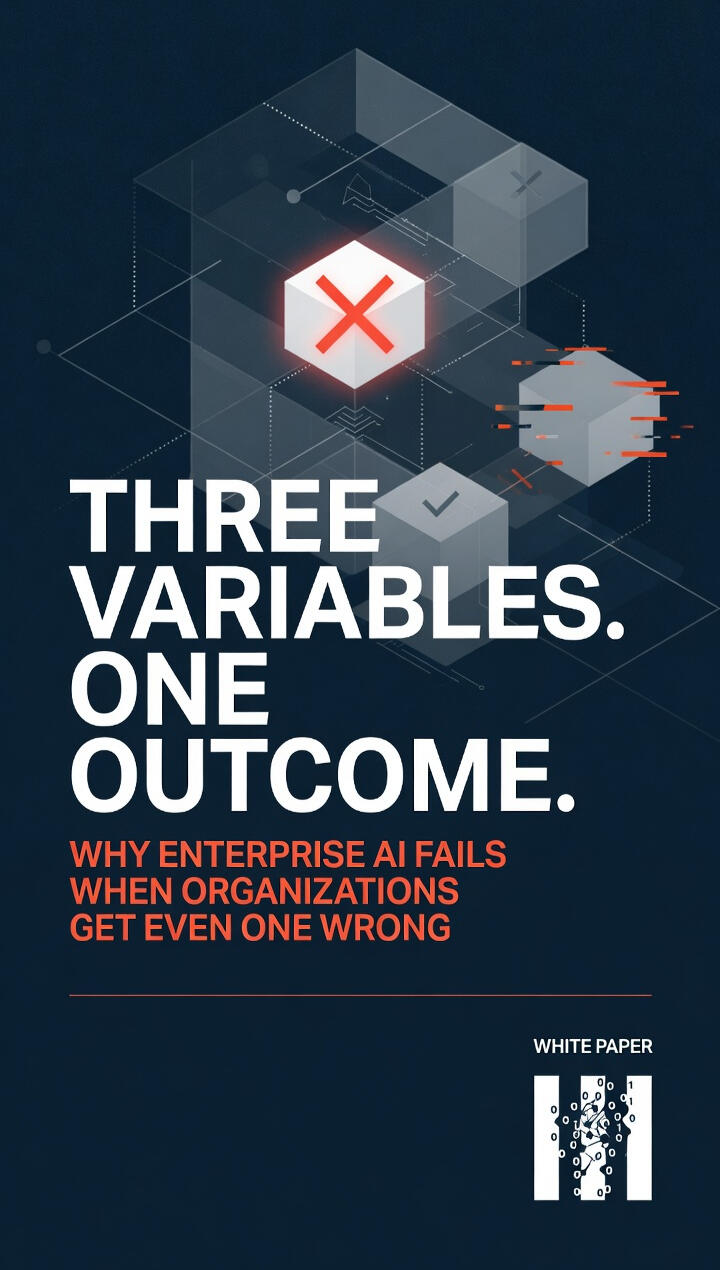
WHITE PAPER
Three Variables. One Outcome: Why Enterprise AI Fails When Organizations Get Even One Wrong
Research consistently places the failure rate of enterprise AI initiatives between 80 and 95 percent. This paper argues that the failure is almost always a systems failure: organizations misalign their strategy, select technology for the wrong reasons, and systematically underinvest in the human conditions that determine whether either of those things ultimately matters. Using a purpose-built implementation equation and Kurt Lewin’s Force Field Theory as its analytical frame, this paper examines each variable in depth — and demonstrates why attending to any two while neglecting the third is not a partial solution. It is a guaranteed path to the same outcome.

FEATURE ARTICLE
While Rivals Stumbled, You Saw the Whole Board
How any CEO can turn a three-variable problem into a competitive advantage — while peers with equal budgets produced nothing but expensive lessons.
GET UPDATES
Coming Soon...
Additional research, articles, and case studies are in development. Get notified when new material is published.
Start With a Conversation
Every PsyTeck engagement begins the same way: with a direct, unhurried conversation about where your organization stands across all three dimensions — strategy, technology, and organizational psychology — and whether there is a genuine basis for working together.If there is, we’ll tell you exactly what we see and what we’d do about it. We will be specific, we will be honest, and we will not tell you what you want to hear if we believe something different. If there isn’t a basis for working together, we’ll tell you that too — and point you toward what would actually help.
The first conversation costs nothing.
The absence of it might cost considerably more.
© 2026 PsyTeck. All rights reserved.